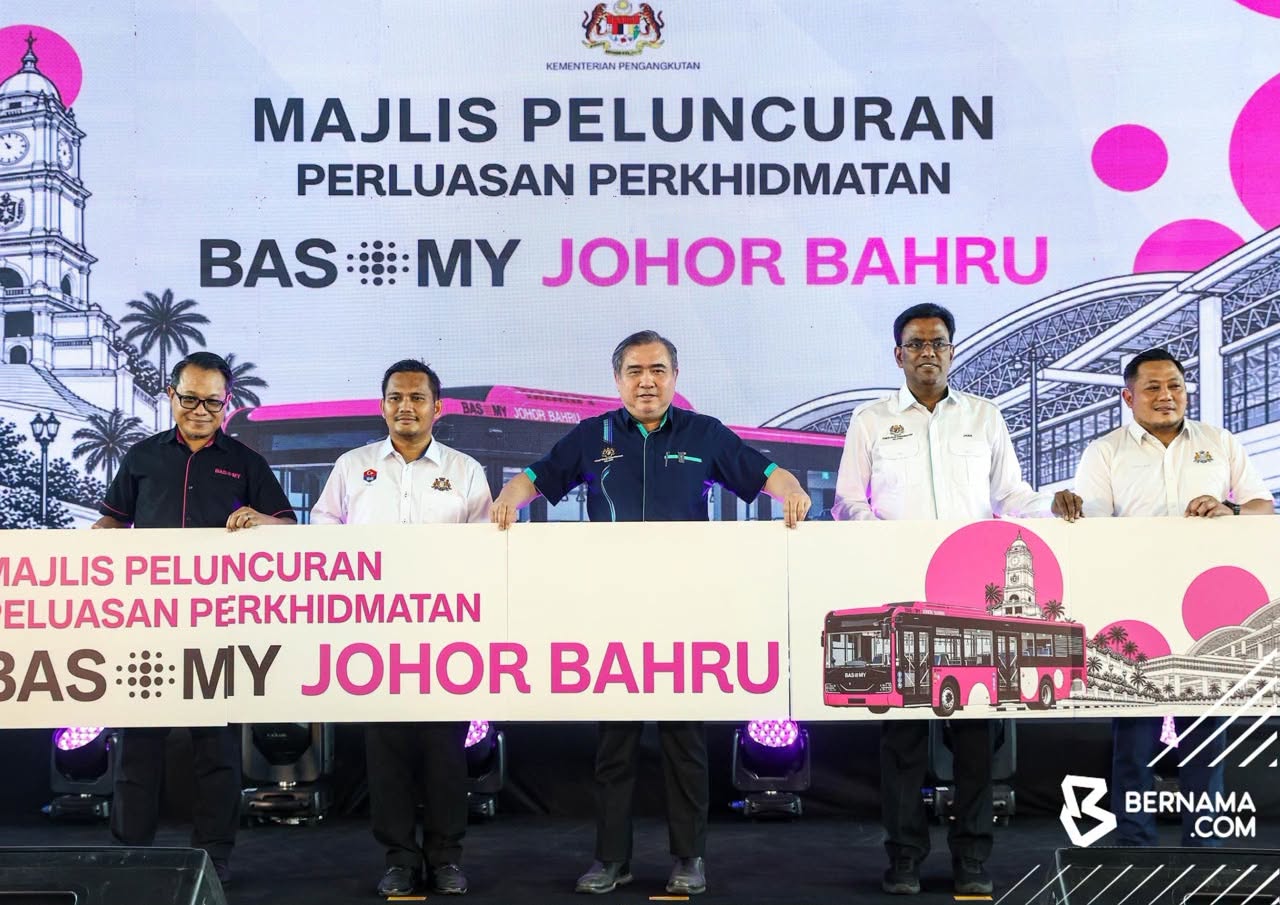
The government has agreed to continue the BAS.MY Johor Bahru service for five years, beginning in 2027, as part of the Stage Bus Services Transformation (SBST) programme.
According to Transport Minister Anthony Loke, the extension will include improvements and expansions to the service network, such as new routes and bus capacity.
He stated that implementation would be done in stages, based on operational requirements and user demand.
“The contract will be finalised soon, involving the addition of 230 new buses and several other conditions,” he said at a press conference after officiating the launch of the BAS.MY Johor Bahru service expansion.
Loke stated that in addition to the extension, efforts are underway to increase service routes to new growth regions and high-demand zones.
These include Terminal Tiram, Johor Jaya, Eco Tropics, Mall of Medini, and Universiti Teknologi Malaysia (UTM).
The increased number of buses seeks to attain a frequency of 15 to 20 minutes for main routes, with feeder routes operating from 20 to 30-minute intervals.
“A total of 20 more organised bus bays will be added (at Jalan Jim Quee near JB Sentral) so that buses can park safely and passengers can board and alight quickly,” he said.
Loke stated that the SBST programme’s stage bus service was implemented in 2022 and has continued to demonstrate great results.
He noted that the BAS.MY Johor Bahru service currently travels around 16 million kilometres every year, serving an average of nearly one million passengers per month. He added that the number of passenger trips increased from 450,000 per month in December 2022 to 1.06 million in December 2025, with a peak of 1.28 million in January of this year.
“With the expansion of the service coverage area, the target is to reach a ridership of 14.99 million passengers annually,” he said.
Loke stated that the development of the BAS.MY service in Johor Bahru is an important component of the passenger dispersal strategy to support the operations of the Johor Bahru-Singapore Rapid Transit System (RTS) Link, which is set to begin in February next year.
He stressed the importance of strengthening the public transport network to provide seamless connectivity and smooth passenger movement.
Meanwhile, regarding the delay of RTS launch, Loke shared that, “I have also been in contact with Singapore’s Transport Minister, and we agreed that the best decision is to commence operations in February so that all processes can be executed optimally.”
He explained that, while RTS Link operations might have begun as early as January, February was chosen as a buffer time to ensure that the entire safety assessment and technical certification procedure runs smoothly.
He noted that the physical construction of the station and the Customs, Immigration and Quarantine (CIQ) complex building is complete; nevertheless, the period from October to December is important for testing and commissioning before the system is turned over on 31st December.