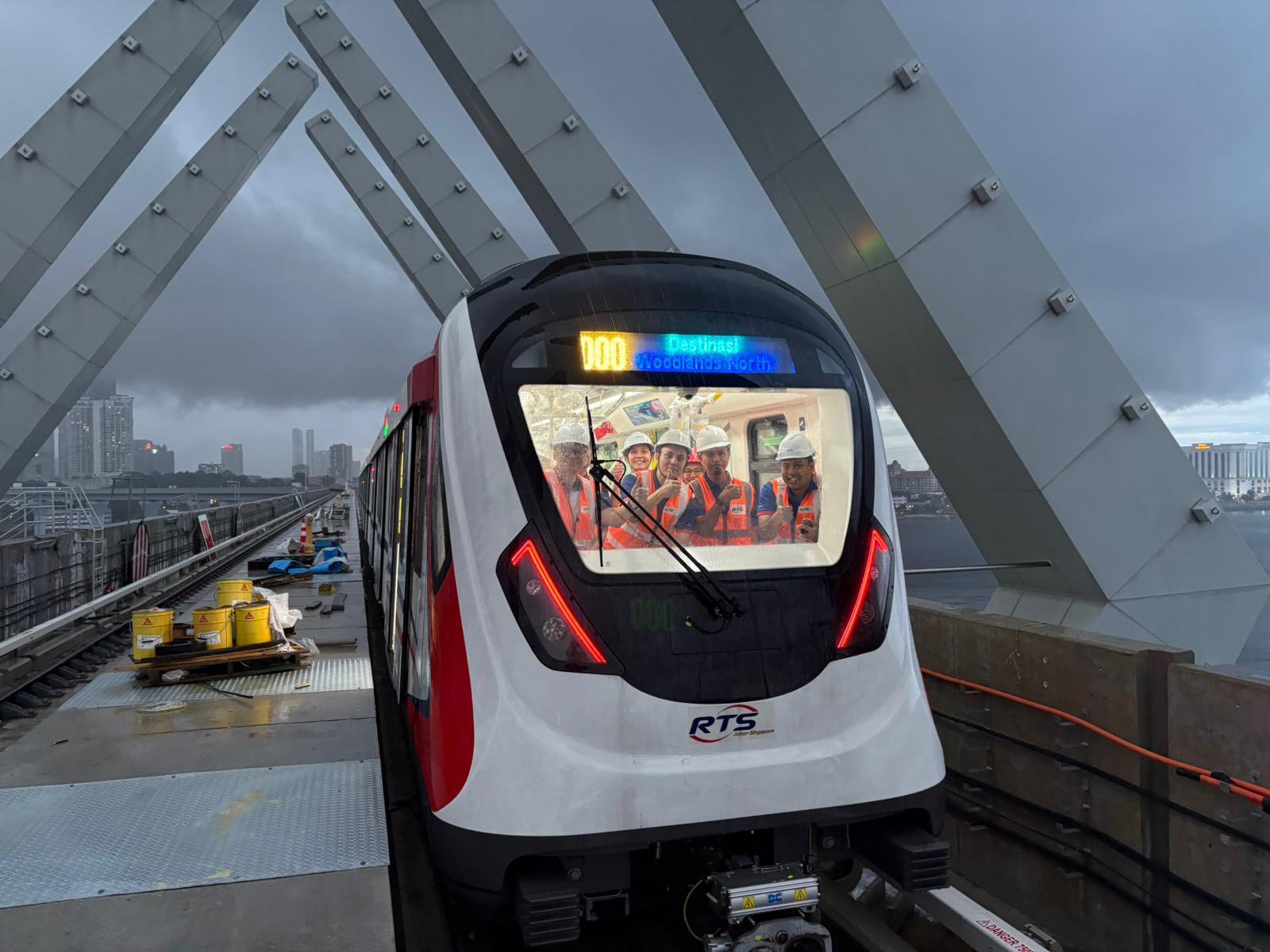
Currently in its final system implementation phase, here is how the RTS Link fits into the economic picture:
The Economic Zone’s Game-Changer
A 4-kilometre light rail shuttle; the Rapid Transit System (RTS) Link will go straight from Bukit Chagar in Johor Bahru to Woodlands North in Singapore. The project is more than 90% finished as of March 2026, and the current focus is on completing power and signalling systems before it opens in January 2027. When the shuttle is operational, it will be able to transport up to 10,000 people each hour in both directions, saving a travel that presently takes 90 to 120 minutes by automobile to a reliable 5-minute train ride. Because of its dependability, Johor Bahru becomes a feasible extended suburb of Singapore, enabling professionals to work in Singapore’s high-tech industries while residing in Johor, or vice versa.
Seamless “Single Checkpoint” Approval
The co-located Customs, Immigration, and Quarantine (CIQ) facility is the most important component for the JS-SEZ’s success. In contrast to the present Causeway experience, which requires travellers to make two stops, RTS passengers will simply need to clear Singaporean and Malaysian immigration at the point of departure. A passport-free QR code system and 100 automatic e-gates at the Bukit Chagar complex support this. The 7-second clearance goal, which is crucial for the 20,000 highly qualified professionals the economic zone seeks to attract, is made possible by the RTS by eliminating the hassle of border crossing.
Currently, the Johor land crossings and major airports are integrating the MyNIISe QR code system, which has finished its initial pilot phase. For those working within the JS-SEZ, the government is introducing a dedicated Investor Pass and a Multiple Entry Visa (MEV) valid for 12 months. These digital passes will allow qualified professionals to clear immigration in roughly 7 seconds using AI-enabled e-gates. Unlike previous systems, the new MyNIISe app even allows families or work teams to clear immigration together using a single group QR code, drastically reducing the bottlenecks that have historically plagued the border.
A Legal Bridge Across the Water
In February, the RTS Link Bill 2026 was passed to guarantee that this one-zone feeling is lawful. This historic law permits immigration officers from Singapore and Malaysia to work together in the same building (the co-located CIQ). It guarantees that official data is safe and untouchable even when stored across borders and offers legal protection to officers working abroad. This legislative framework is the “invisible” component of the JS-SEZ that enables the 5-minute rail travel, guaranteeing that you can enter the other nation immediately after clearing immigration at your point of departure.
Additionally, the reciprocal principle also requires Singapore to amend its domestic laws to provide equivalent protection to Malaysian officers before the Bill comes into full force on 30th September 2026.
Effects on Real Estate
Property values have already increased due to the RTS effect; over the past two years, the value of certain ideal locations close to the Bukit Chagar station has doubled. Developers are working quickly to finish transit-oriented projects that directly connect the station with residential, commercial, and retail sectors. Industries can maintain their headquarters in Singapore’s financial district while transferring technical teams to their manufacturing or data center facilities in Johor with ease thanks to the RTS, which serves as a physical bridge for the “Singapore + 1” strategy. Even before the official master plan announcement, Singaporean companies have already invested more than SGD$5.5 billion in the zone, primarily due to this connectivity.
While the formal JS-SEZ blueprint launch is momentarily on hold, the infrastructure and travel systems are moving full speed ahead.