According to Economy Minister Akmal Nasrullah Mohd Nasir, the Johor-Singapore Special Economic Zone (JS-SEZ) received RM88.83 billion in approved investments between January 2025 and June 2026, with projects anticipated to generate 28,755 job opportunities.
45% of the authorised investments (RM40.30 billion), have been realised. It is anticipated that these investments will create 12,796 employment.
According to Akmal, the current emphasis is on turning the zone’s investment potential into observable outcomes through robust dedication and productive collaboration between Singapore and Malaysia.
“We definitely want to keep up this good momentum, and it will benefit both nations, the people, and the business communities but the real challenge and commitment by both countries is to deliver this prospect with a really good outcome,” he said.
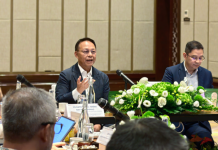
He was speaking to the media in a joint press conference after co-chairing the inaugural Johor–Singapore Cooperation Ministerial Committee (JSCMC) together with Singapore Minister for National Development Chee Hong Tat. Also present was Johor Menteri Besar Dato’ Onn Hafiz Ghazi.
Akmal stated that the JSCMC is a calculated step taken by both nations to improve coordination, bolster bilateral collaboration, and keep an eye on the execution of JS-SEZ major projects.
The JSCMC established a Joint Ministerial Committee, which will be co-chaired by Singapore’s Minister of National Development and Malaysia’s Minister of Economy.
The Johor Menteri Besar and the Minister of Investment, Trade, and Industry will represent Malaysia, while the Ministers of Energy and Industry and Transport will represent Singapore.
He also said both countries had agreed to organise a joint investment forum in the first quarter of 2027.
In the meantime, he said the upcoming JS-SEZ blueprint, scheduled to be launched by both Prime Minister Datuk Seri Anwar Ibrahim and Prime Minister Lawrence Wong in December 2026, will pave the way for a better prospect within the economic zone in the near term.
“With this blueprint in place, we expect the momentum for 2027 will be hopefully higher in terms of the commitment from both countries,” he added.
Meanwhile, Chee stated that the forthcoming JS-SEZ blueprint reflects the medium- to long-term goals that both nations have for the area.
He shared that numerous agencies from both nations would need to collaborate closely to enhance cooperation and supervise the execution of particular projects in order to realise the goal set in the JS-SEZ blueprint.
These include developing talent, easing the flow of people and products, encouraging investment and trade, and improving connection and transportation. All of them, in my opinion, are crucial supporting components for realising the advantages of win-win collaboration and bringing the blueprint to life,” he concluded.