
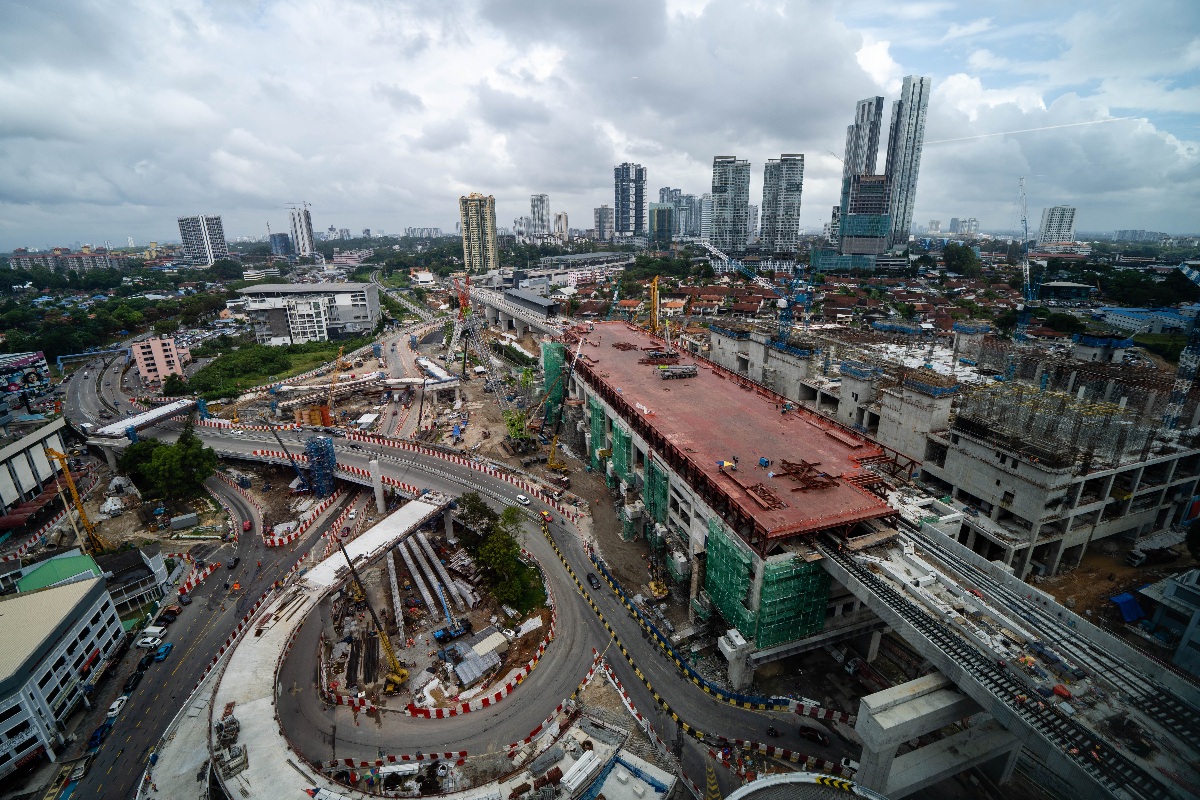
A contraflow lane will be installed along the Senai-Johor Bahru corridor, particularly Jalan Skudai, to alleviate critical traffic congestion following the start of the Johor Bahru-Singapore Rapid Transit System (RTS) Link operations by year-end.
Mohamad Fazli Mohamad Salleh, chairman of the Johor Public Works, Transport, Infrastructure, and Communications Committee, said the measure would be trialled for three months before being implemented in the third quarter of this year, subject to approval from the relevant authorities.
“This (approach) will reduce congestion and daily travel time as a practical interim solution,” he said during the oral question-and-answer session at the Johor State Legislative Assembly, which is meeting at Bangunan Sultan Ismail on 6th May 2026.
He stated that the first phase of the contraflow lane implementation would include a six-kilometre stretch from Batu 7 Jalan Skudai to Bandar Baru Uda, specifically for traffic entering the city centre.
“The lane would operate during peak hours from 5.30 a.m. to 9 a.m., involving only light vehicles, using a movable barrier system supported by LED signboards and on-ground traffic control to ensure safety and smooth operations,” he said.
Mohamad Fazli stated that a data-driven approach had been used to assess preparedness for the increased traffic flow following the RTS Link operations, including the “Greater Johor Bahru & JS-SEZ Traffic Dispersal and Congestion Action Plan” study conducted by the Johor Public Transport Corporation (PAJ).
He stated that the study identified 77 congestion hotspots divided into 41 clusters, with 24 serious clusters in Johor Bahru, Pasir Gudang, Iskandar Puteri, and Kulai.
In this regard, he stated that various mitigation measures had been and were being implemented, including proposed priority projects under the Skudai corridor involving road upgrades and closures in multiple areas.
According to him, Bas.my Johor will be the primary route for ensuring comprehensive RTS Link connectivity.
While Bas Muafakat Johor would provide feeder services in Kota Iskandar’s key residential areas, the first and last-mile approaches would include pedestrian, cycling, and park-and-ride facilities.
Concerning cargo lorry congestion on roads, he stated that logistics companies are encouraged to use the 39.9-kilometer Kempas Baru-Pasir Gudang Cargo Service Rail Line, which connects Kempas Baru, Seelong, and Johor Port in Pasir Gudang and was upgraded at a total cost of RM55 million.
He went on to add that route coordination, logistics traffic and daily traffic separation, special route designation, and lorry movement schedule coordination with border and port operations had all been implemented to address heavy vehicle congestion.


 Link operations by year-end)