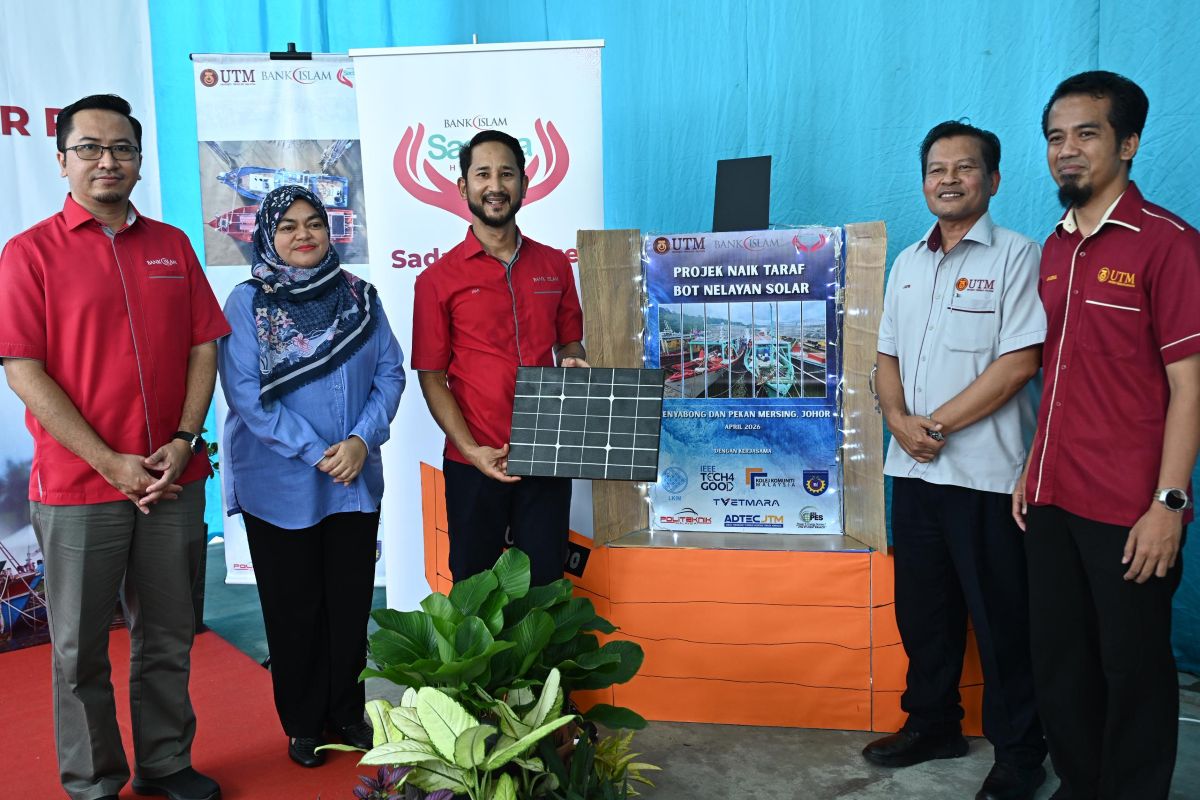
Bank Islam Malaysia Berhad (Bank Islam), continues to strengthen its sustainability and financial inclusion commitment with the expansion of its Smart Eco-PV Boat project, delivering solar-powered fishing boats to the coastal fishing community in Penyabong, Mersing, Johor. The project is implemented through its award-winning social finance arm, Sadaqa House, in collaboration with Universiti Teknologi Malaysia (UTM) and supported by Lembaga Tabung Haji.
Designed through the Social Return on Investment (SROI) framework, the Smart Eco-PV Boat project in Penyabong supports 25 fishermen from the local fishermen resettlement area with a total project value of close to RM150,000. Each participating fisherman is estimated to save approximately RM150 per month on diesel costs, reducing operating expenses while improving income stability. It delivers tangible and measurable outcomes, including lower fuel dependency, reduced carbon emissions, improved operational efficiency, and safer, more sustainable energy consumption that supports marine conservation.
Bank Islam’s Group Chief Executive Officer, YM Raja Datin Paduka Teh Maimunah Raja Abdul Aziz said, the initiative reflects the Bank’s conviction that sustainability must translate into measurable benefits for communities.
“By integrating renewable energy solutions into the fishermen’s daily operations, we are lowering costs, strengthening livelihoods and reducing environmental impact. More importantly, we are demonstrating how Islamic social finance can be mobilised to deliver practical, scalable and dignified outcomes for the underserved communities. The current rollout builds on the Bank’s pilot project introduced in 2024 in Perkampungan Sungai Muka Dua, Mersing, Johor where solar PV systems were installed on 21 fishing boats owned by B40 and underbanked fishermen, with a total project value of more than RM100,000.”
She added that pilot project represented a significant milestone, as it marked our first solar PV deployment dedicated specifically to fishing boats, rather than residential use and into productive income generating activity. Supported by strategic collaborations with UTM, this approach enables us to combine funding with technical expertise and capacity building to deliver scalable, real-world impact that accelerates Malaysia’s energy transition and inclusive socio-economic development.
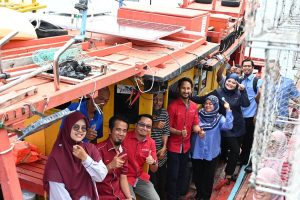 In line with its inclusive development objectives, the project also incorporates microenterprise empowerment initiatives, alongside upgrades to shared working infrastructure. These enhancements include the installation of an awning roof at the old jetty’s store building, creating safer and more efficient covered space for storage, organisation and repair of fishing cages. The upgraded facilities also benefit the 105 members of the Penyabong Fishermen Association.
The project was officially launched in a ceremony attended by Bank Islam’s Group Chief Operating Officer and Group Chief Sustainability Officer, Mohamed Iran Moriff Mohd Shariff, and UTM’s Dean of the Faculty of Electrical Engineering, Professor Dr Jafri Din, as well as officials from the Fisheries Development Authority of Malaysia (LKIM).
Prior to the launch, participants attended a series of knowledge-sharing sessions, including briefings on energy efficiency and cost savings achieved through the adoption of solar photovoltaic (PV) technology. The programme also featured an interactive quiz session that engaged both project beneficiaries and local school students, reinforcing practical awareness of renewable energy solutions at the community level.
Beyond direct community benefits, the project serves as a practical platform for knowledge transfer and hands-on learning for UTM and its partner institutions, including community colleges, industrial training institutes, and polytechnics across Johor.
Sadaqa House’s collaboration with UTM, which began in 2018, has delivered meaningful community impact through the successful installation and maintenance of solar power systems across four Orang Asli communities in 2019 until 2023, and one fisherman village in 2021, ensuring the continued reliability and long-term impact of the clean energy solution.