Twenty years after its establishment to accelerate the economic development of southern Johor, Iskandar Malaysia is entering a new phase of growth — where success is measured not only by the scale of investment secured, but by the productivity, technology, skilled jobs, Malaysian capabilities and wider regional value that investment creates.
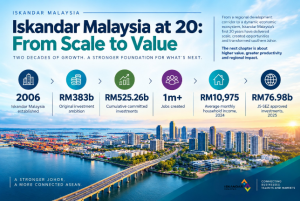
The region has already exceeded its original investment target, with cumulative investments reaching RM525.26 billion, compared with the initial target of RM383 billion. More than one million jobs have been created, while average household income has more than doubled over the development period.
With this foundation in place, the next phase is focused on raising the quality and economic value of growth.
Greater emphasis is being placed on attracting and growing higher-value activities across advanced manufacturing, digital and data-driven industries, logistics, financial and business services, and other sectors that strengthen Johor’s position within regional and global value chains.
Beyond the initial investment, the focus is increasingly on what remains within the economy — through local supply chains, technology transfer, talent development, innovation, intellectual property and stronger Malaysian enterprises.
From investment scale to economic value
As competition for investment across ASEAN becomes more sophisticated, cost and land availability alone are no longer sufficient differentiators. Investors increasingly seek integrated ecosystems supported by infrastructure, energy security, talent, digital connectivity, efficient movement of goods and people, regulatory coordination and access to regional markets.
The Johor-Singapore Special Economic Zone (JS-SEZ) adds a significant dimension to this proposition. The JS-SEZ recorded RM76.98 billion in approved investments in 2025, reinforcing Johor’s potential as a complementary economic partner to Singapore.
“As Iskandar Malaysia marks 20 years of development, our priority must be to build on the foundations established and translate the region’s economic achievements into greater value for Malaysia. The Johor-Singapore Special Economic Zone (JS-SEZ) presents an important opportunity to deepen regional economic integration, attract higher-value investment, strengthen Malaysian businesses and develop the talent and capabilities needed to compete in regional and global markets. The next phase must be measured not only by the investments we attract, but also by the quality of opportunities we create, the strength of our economic ecosystem and the lasting benefits delivered to businesses and communities. Through continued collaboration between the Federal and State Governments, industry and other stakeholders, we can strengthen Johor’s position as a regional economic hub and ensure that Iskandar Malaysia’s next chapter delivers meaningful outcomes for Malaysia,” said Datuk Amar Haji Fadillah bin Haji Yusof, Deputy Prime Minister II and Minister of Energy Transition and Water Transformation, who co-chaired the 36th Meeting of the Members of Authority of the Iskandar Regional Development Authority (IRDA MoA) on behalf of Dato’ Seri Anwar Ibrahim, Prime Minister of Malaysia, alongside Dato’ Onn Hafiz bin Ghazi, Menteri Besar of Johor.
The opportunity now is to translate this momentum into an integrated cross-border ecosystem — combining Johor’s land, industrial capacity, talent and cost competitiveness with Singapore’s strengths in capital, business services, technology, connectivity and international markets.
This requires coordinated progress across investment, infrastructure, energy, talent, customs and immigration arrangements and cross-border connectivity, positioning the JS-SEZ not simply as an investment zone, but as a regional economic platform.
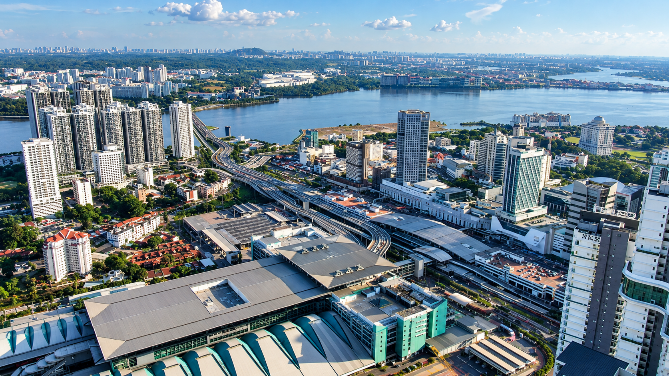
As the JS-SEZ accelerates cross-border economic activity, its long-term success will also depend on ensuring that growth is inclusive, liveable and sustainable for local communities. This includes addressing potential pressures on housing affordability, urban mobility, access to public amenities, and community connectivity, while managing the risk of gentrification and climate-related impacts. Integrating these considerations into urban planning will be essential to ensuring that major developments, including the JS-SEZ and Rapid Transit System (RTS), strengthen the region’s economic competitiveness without compromising social well-being or the long-term resilience of Iskandar Malaysia.
Building stronger Malaysian capabilities
The next stage of Iskandar Malaysia’s development must also strengthen domestic capabilities.
Closer collaboration between industry, universities, Technical and Vocational Education and Training (TVET) institutions and the wider talent ecosystem will be critical to ensuring that the workforce evolves alongside a more technology-intensive and knowledge-based economy.
The opportunity extends beyond positioning Johor as a competitive location for international companies. It is about enabling Malaysian talents and businesses to move further up the value chain — in technology, innovation, engineering, product development and intellectual property — while creating opportunities for local companies to become suppliers, partners and eventually regional players.
In short, the next phase is not simply about bringing more investment into Johor, but increasing the economic value created from that investment.
Growth that is competitive and resilient
Economic competitiveness is also increasingly shaped by liveability, environmental performance and resilience.
Under the Comprehensive Development Plan (CDP) iii (2023–2030), Iskandar Malaysia’s development agenda is structured around four interconnected priorities: High Value Economy; Productive Society; Climate Resilient and Carbon Neutral; and Integrated and Liveable City.
This reflects a broader understanding of competitiveness, where infrastructure, talent, sustainability and quality of life are increasingly integral to the investment proposition.
The next 20 years will be defined by delivery
The first 20 years of Iskandar Malaysia were about establishing scale, infrastructure and economic momentum. The next 20 will be increasingly judged by what that foundation delivers.
The priorities are clear: higher-value investment, stronger productivity, greater technology and knowledge transfer, deeper participation by Malaysian companies, more skilled employment and stronger integration with regional markets.
With the JS-SEZ providing an important platform for this next stage, Iskandar Malaysia is positioned within a wider economic geography that extends beyond the Malaysia-Singapore relationship to the broader ASEAN market.
The opportunity ahead is therefore not simply to grow bigger, but to grow more productively, more strategically and with greater regional impact.
After two decades of building the foundations, Iskandar Malaysia is moving from investment to value, from potential to delivery, and from regional growth to regional impact.