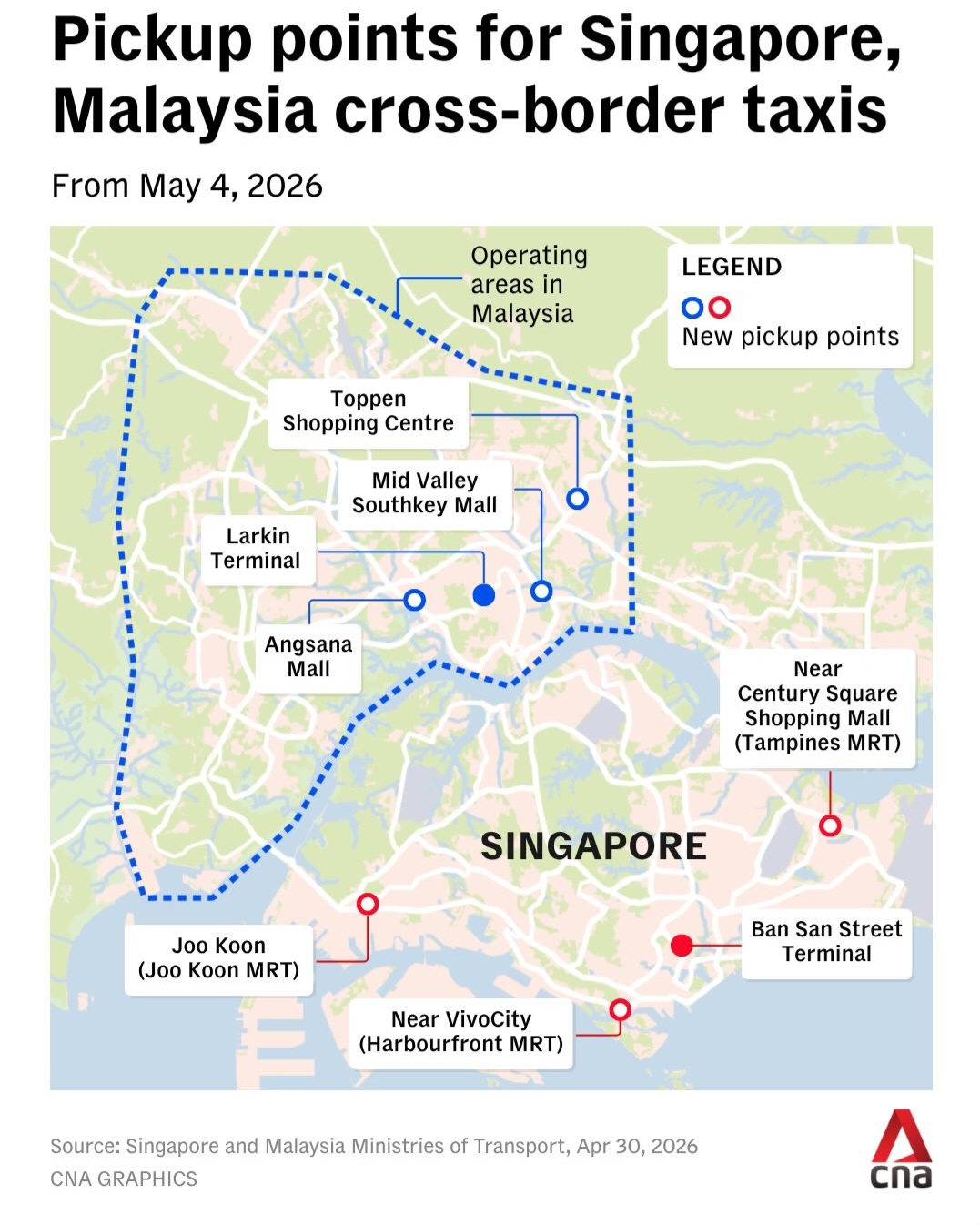
Beginning 4th May 2026, passengers wishing to take cross-border taxis from Johor Bahru back to Singapore, will be able to board them from more locations.
Additionally, they will be able to get off anywhere in Johor Bahru, Iskandar Puteri, Forest City, Kulai, and Senai.
In a joint statement on 30th April, the transportation ministries of both Malaysia and Singapore stated that doing so would make travel more convenient. Currently, after crossing the border, cross-border taxis are only permitted to use one specific pickup and drop-off location.
Taxis registered in Singapore must go to Larkin Sentral Terminal, Johor Bahru’s primary public transportation hub. In contrast, their Malaysian counterparts are only able to do so in Bugis’ Ban San Street Terminal.
The modifications allow taxis registered in Singapore to pick up customers at Toppen Shopping Centre, Mid Valley Southkey Mall, and Angsana Mall. Meanwhile, Malaysian taxis are available at the Joo Koon MRT station, the Century Square Shopping Mall in Tampines, and the VivoCity shopping complex.
A regular four-seater automobile will now cost SGD$80 for pickups from Ban San Street Terminal to Larkin or any other location within 35 kilometers. There will be an extra SGD$20 for any other area. The current cost of hailing a cross-border taxi to Larkin is SGD$60.
Six-seaters will be added to the list of available vehicle options in addition to the fare hike.
Standard and premium options will be available; the standard option will cost SGD$120, while the premium option will cost $180. Any other location will cost an extra SGD$30.
In contrast, Malaysian cross-border taxis will be nearly identical to their Singaporean counterparts, with the least expensive model, a four-seater, costing RM240.
The modifications, which are intended to make travel between the neighbouring nations more convenient.
Additionally, both nations said at the time that they would progressively raise the licensed taxi quota from 200 to 500, albeit incrementally.
According to a statement released by the ministries on 30th April, the first increase will be 100 taxis, with larger and more upscale vehicles being given priority to meet the needs of larger parties and business travellers.
A black market with businesses providing illicit services has emerged as a result of the unmet demand for legal cross-border taxi services.
Since ride-hailing drivers in Singapore gave them information about automobiles registered in Malaysia that appeared in places like Changi Airport and Gardens by the Bay after transporting passengers within the nation, Singaporean officials have begun cracking down on these services.
Licensed cross-border taxis must have distinctive liveries on both sides of the vehicle that identify them as such in order to combat this.
Additionally, Singapore’s next-generation Electronic Road Pricing system will require Malaysian cross-border taxis to equip on-board units and have license plates that start with “H,” while Singaporean taxis would have the prefix “SH.”