The text message from my friend, who is familiar with the stuff that interests me, read like this:
“I wanted to share with you about my batik shirts. Lately, I’ve opted to wear more Batik Johor and it’s all from this shop in Kompleks Kraf Johor called, Imarazak. They use Johor motifs like pepper, gambier and pineapple, and they also offer batik printing classes at their shop.”
It is no secret that I have an inherent interest in Johor culture and heritage, so key words like batik along with, Johor motifs of pepper, gambier and pineapple, certainly appealed to me.
I did not hesitate to get the contact details and asked him for a favour to make an e-introduction before I arranged our meet-up at their shop.
I am familiar with Kompleks Kraf Johor, located in Larkin off Jalan Datin Halimah, and when I arrived at the carpark, Madam Ima herself was waiting there to welcome me in.
She explained that their brand name, Imarazak, was coined from her name in one part with the other part made up of her husband’s name, Razak.
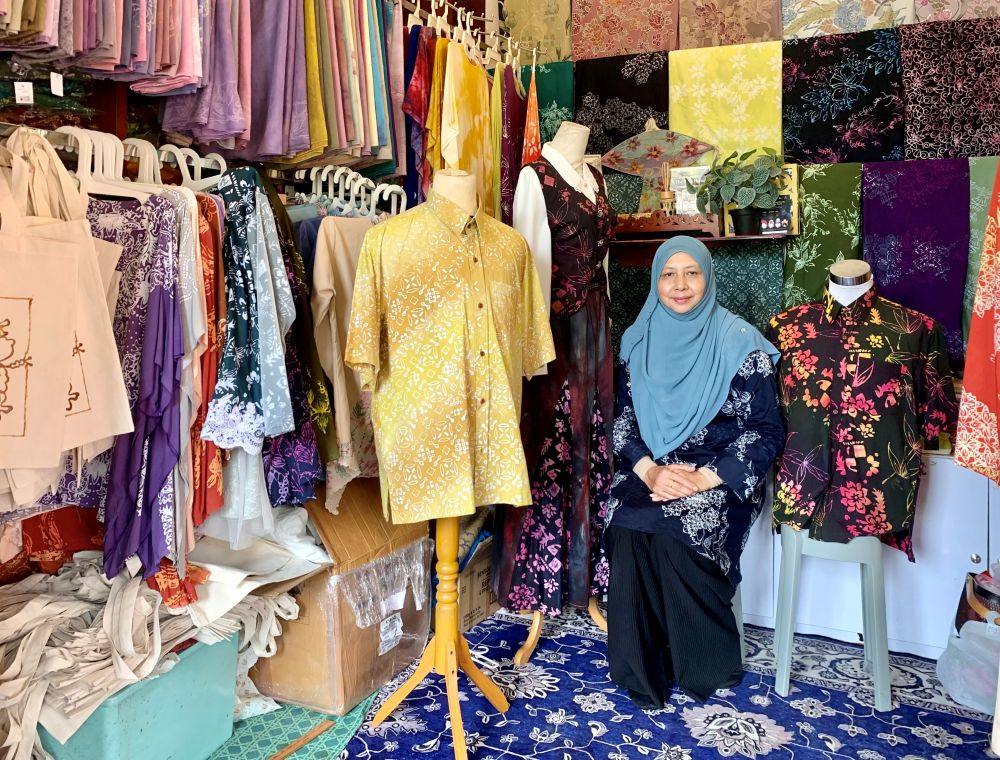
My eyes zeroed in on a golden balloon in the shape of the digit nine, floating against the rack of batik shirts on display, and Ima was quick to share that they were commemorating their Ninth Anniversary since the brand was registered in 2017.
Madam Ima clarified that her name is Rafidah Ahmad while Ima, was her home name when she was growing up in Kampung Tanjung Adang, Gelang Patah.
This struck a familiar chord with me because my dad was posted to work at the Government health dispensary in Gelang Patah, Johor, in the 1960s and he had good friends in Kampung Pok, the village that Ima told me, was next to Kampung Tanjung Adang.
As we chatted about her journey to Imarazak, I learnt that Ima has a background in Engineering, more specifically, in the specialised field of High Radio Frequency Nano Technology.
She had a successful career with multinational companies in Shah Alam, working in their Research & Development team with the opportunity to develop her skills through further research studies abroad.
At that stage in her life, she was a mother to five children with ages that ranged from seven years to five months old. With her mother advanced in age and her husband ill, she had to make a decision to choose between advancing her career or being with her family.
Ima then reached the decision to uproot herself from Shah Alam, accepted a job opportunity in Iskandar Puteri and moved closer to her mother in Johor.
As the Radio Frequency Designer of a special device, her work (again!) required her to be in the UK for three years with six months in Japan. Once again, she was faced with the tough decision of choosing between career and family.
To Ima, her family always comes first.
Armed with professional skills from her engineering career, she forged ahead as a trader in batik and curated an exclusive collection of all types of high-quality, beautiful batik from various Malaysian states, available to discerning customers from her boutique and art gallery, opened in Iskandar Puteri.
Ima made good use of the six years as a trader in batik to study her target market and successfully met their tastes for premium quality fabrics that reflect traditional heritage and handled the business with a modern approach.
From trading in batik, Ima turned to learning more about the art of creating batik. At a special workshop organised by Kraftangan Malaysia, a batik tutor from Terengganu was invited to conduct training in the art of canting and block printing.
Ima gave much thought into choosing to pursue the art of creating batik using the canting method or the block printing method and after much deliberation, she decided on acquiring the skills in block printing.
With the Imarazak brand established, her batik business relocated to the current premises in Kompleks Kraf Johor where there was space to create her own designs using the block printing method.
Then under a Johor Corporation branding exercise in 2017, she registered IMARAZAK TRADITIONAL & MODERN as ‘The Batik House’ with a tagline, Batik Comes Alive.
When the global pandemic reached our shores in 2020, Ima had no alternative but to work-from-home. In such a challenging situation, she applied her engineering skills to modify equipment and techniques to continue creating batik using the block printing method at home, to meet with her customers’ requests.
Her social-media savvy sons, Danial and Faris, supported her home-based business by creating an online presence on various platforms and she was able to keep her brand alive throughout the lockdown period by creating custom-designed fabrics.
I observed that Ima was proud of how they were able to commit to deliver on time, her exclusive products that were made according to the customers’ choice in fabric, colours and designs.
She cited the example of a Malay wedding where the customer required a number of two-metre batik printed fabrics for the ladies’ traditional costumes. And when she was able to meet the customers’ requirement, they added to their order, five-metre fabrics for the men’s costumes.
It was clear that her experience garnered from the years as a Research & Development engineer-turned-trader in batik, a useful time of training and learning for her own advancement in the world of creating meaningful batik, a unique form of wearable art with a story.

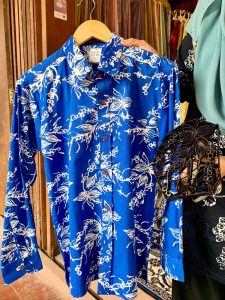
Ima then showed me a framed piece of batik she created that featured the Johor motifs of pepper and gambier with fronds of the piai fern, and told me about the Batik Lestari Competition in 2024, where she was shortlisted among the top 20 from some 80 participants.
The shortlisted participants were invited to present a pitch and share their response to the question, “What do you know about sustainability?”
By then, her sons had joined the business where Faris was applying his skills in block printing fabrics while Danial continues to support in sales and on social-media.
In her presentation, Ima was able to share about the heritage element of the motifs used in the design of her batik fabric: Pepper and gambier that represent the lucrative spice trade and the first economy crops that put Johor on the world map as the world’s largest producer of gambier in the 1800s, and piai leaves, a coastal fern that grows abundantly in mangrove forests, essential plants that protect the delicate coastal eco-system.
Ima discussed the route to growth and sustainability by having a succession plan where her sons were hands-on involved in

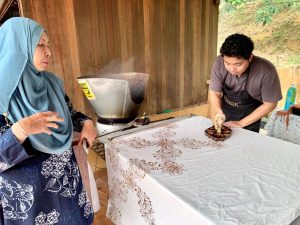
the business, and having seen the process and the work involved in producing quality fabrics, they can better appreciate the final products.
She was also unselfish about her skills and knowledge, ready to share her journey with the younger generations by collaborating with colleges and universities, open to accepting practical trainees and interns who wish to learn batik-making techniques.
As Ima shared, I could feel her passion for creating batik designs that aimed to elevate Malaysian batik by showcasing the Johor identity to the world through the production and marketing of quality products with exclusive and contemporary designs.
While I was there, a walk-in customer came to look at the smart shirts and Danial helped to pick out one that met with his taste and size.
Then one-by-one, Ima showed me her designs that were tailored from cotton and satin cotton fabrics, created in trendy colours like teal and olive, or according to the customer’s requirement or corporate colours.
When Ima showed me a batik design used on a cold bag that she designed for Tea Garden, I instantly recognised it from a Ramadan promotional event at Tea Garden in 2024. As Ima pointed to her signature on the design that featured Bunga Raya (Red hibiscus) and Bunga Telang (Blue pea flowers), it was good to know that she was, in fact, the designer.
Among Imarazak’s recent customers were brands like UDA Holdings, Tea Garden, Desaru Coast, the Johor Heritage Foundation and Gleneagles Hospital, and collaborators like Universiti Teknologi MARA, Universiti Tun Hussein Onn Malaysia, Universiti Teknologi Malaysia and Southern University College.
Ima told me she was pleasantly surprised when a team from Yayasan Raja Zarith Sofiah, Negeri Johor or the Raja Zarith Sofiah Foundation, Johor, visited Imarazak – The Batik House, to learn more about Ima and her use of Johor motifs in her designs.
She was more than pleased when they presented her with a plaque as a sign of approval from Yayasan Raja Zarith Sofiah, Negeri Johor for what she was doing to preserve and promote the Johor identity through her useful and wearable art work.
No, she has no plans to move into a mall where there were more footfalls. At Kompleks Kraf Johor, Imarazak welcomes visitors and groups to watch how block printing was done and take part in batik painting using a paintbrush or the canting.
Congratulations on your Ninth Anniversary and wishing Imarazak greater heights of success as more customers; many of them repeat customers, appreciate the quality in their products and services that meet with the customers’ tastes and requirements.
Imarazak – The Batik House, is at Wakaf No. 1, Craft Valley, Kompleks Kraf Johor, Jalan Cendersari, off Jalan Datin Halimah, 80350 Johor Bahru, Johor. Open from Monday to Sunday from 10am to 5pm. For enquiries, Tel: +6019 2779275.
For info and updates, visit Imarazakbatik official pages on Facebook, Instagram and TikTok as well as YouTube to view videos.