
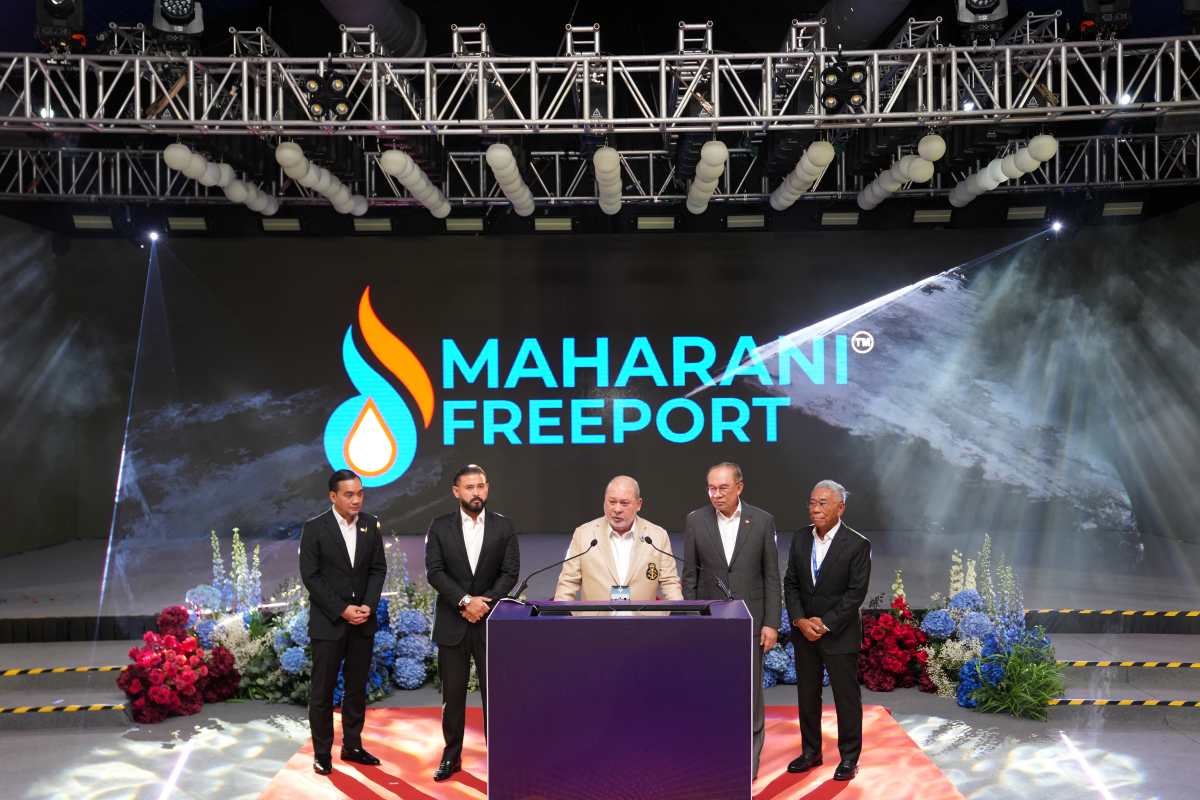
Maharani Freeport, Malaysia’s first duty-exempted energy freeport built to be the nation’s energy and maritime services hub, was officially launched by His Majesty Sultan Ibrahim King of Malaysia.
The Johor State Government and the Federal Government both support the deepwater freeport, which is being developed by Maharani Energy Gateway Sdn. Bhd. (MEG). Maharani Freeport’s designation as a National Project highlights its critical role in furthering Malaysia’s long-term goals in trade, energy, and the economy.
Located within the Muar Port limits along the Strait of Melaka, the world’s largest oil shipping route, Maharani Freeport positions Malaysia alongside other major global freeports.
In the long term, Maharani Freeport is expected to attract RM144 billion in investment value from global investors and generate a significant multiplier effect for the local Johor and Malaysian economy.
Speaking at the launch, Dato’ Dr Daing A. Malek Bin Daing A. Rahaman, Executive Chairman of MEG, said the event marked a historic milestone for Muar, Johor and Malaysia.
“Maharani Freeport is a bold and transformative project. Our goal is to raise living standards, create new opportunities and anchor Johor as a driver of Malaysia’s economic future.
“It is expected to generate hundreds of new high-value companies, and when combined with the supporting industries, this initiative is forecasted to create at least 45,000 of direct and indirect jobs, and uplift local businesses in logistics, ship repair, construction and services,” he said.
Dato’ Malek added that Maharani Freeport is already operational. “It is not just an aspiration or a vision for the future. It is already doing business, conducting oil trading, storage, transhipment, blending and mixing, and facilitating other services such as bunkering, marine, deep seaport, floating storage unit, ship-to-ship transfer for our customers and partners.”
The launch ceremony was graced by the attendance of over 1,500 guests including HRH Tunku Ismail ibni Sultan Ibrahim, the Regent of Johor, members of the Johor Royal Family, Prime Minister Dato’ Seri Anwar bin Ibrahim, Johor Menteri Besar Dato’ Onn Hafiz, ambassadors and high commissioners from more than 30 countries, senior federal and state government officials and members of the local and international business community.
Dato Malek expressed deep appreciation to the His Majesty Sultan Ibrahim King of Malaysia, HRH Tunku Ismail, the Prime Minister, the Johor State Government and numerous ministries and agencies for their support.
“Where others see challenges, His Majesty sees opportunity. His wisdom and foresight made it possible for Maharani Freeport to take root in Muar.
“Maharani Freeport represents the best of what Malaysia can achieve when vision meets determination and collaboration meets purpose. We are built to lead, to challenge convention, and to seize the opportunities of a rapidly changing global landscape. With the support of all, Maharani Freeport will become a global energy port shaping tomorrow’s innovation,” he said.
The Maharani Freeport masterplan spans 3,200 acres of reclaimed land across three man-made islands and comprises four major components: Maharani Energy Hub; Maharani Deep Seaport; Maharani Freeport Industrial Park; and Maharani Freeport Financial Hub.
It will be a one-stop hub in the Strait of Melaka, from oil trading, storage and blending to deep-seaport capabilities, bunkering and ship maintenance. Its 24-metre natural depth enables the berthing of Very Large Crude Carriers (VLCCs) and other large vessels, providing a secure and cost-efficient alternative for maritime operators.
Other planned facilities include petrochemical complexes, renewable energy production, STS operations, floating storage units, shipbuilding and repair yards, and digital platforms powered by AI and blockchain.
Maharani Freeport delivers a comprehensive service ecosystem coupled with significant operational cost efficiencies driven by its robust tax incentive structure that includes zero corporate tax and conducive foreign participation policies for businesses that are registered within the Freeport. For those in the oil trade and related activities, the low 3% corporate tax rate is among the most competitive in the region.


