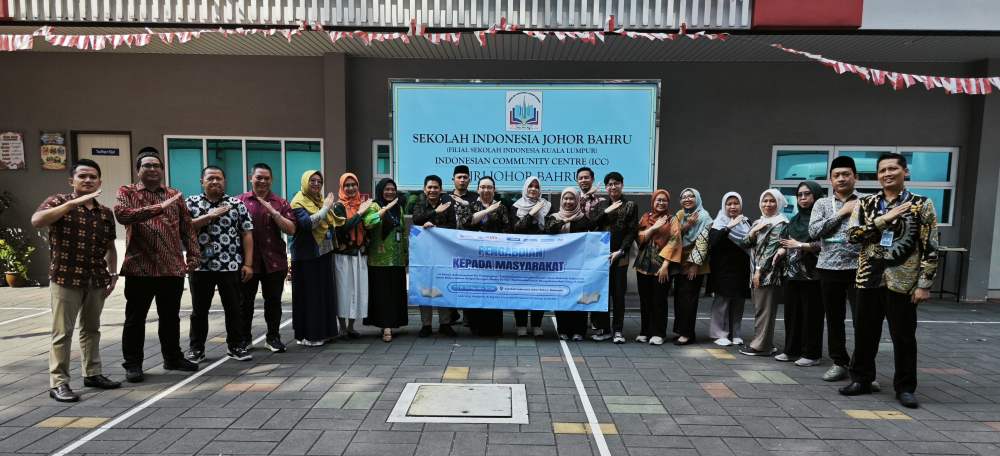
Teachers at Sekolah Indonesia Johor Bahru (SIJB) have completed a hands-on programme on using artificial intelligence to produce classroom materials, following a three-day visit by a team from Universitas Pendidikan Indonesia (UPI), Bandung, from 19th to 21st August 2026.
Held at the Indonesian Community Centre in Johor Bahru, the programme was the culmination of five weekly online sessions that began in mid-July. It was organised by UPI’s Learning Analytics and Digital Assessment Research Group in collaboration with the Consulate General of the Republic of Indonesia in Johor Bahru.
The programme responded to a practical problem raised by the school itself. With a small teaching staff, most SIJB teachers handle three to four subjects across different year levels, leaving little time to prepare lesson materials in more than one format. Most existing materials were text documents and slides.
Participants were trained to use NotebookLM, a Google platform that generates summaries, concept maps, infographics and audio discussions based only on documents the user uploads. Because the tool draws solely from the teacher’s own sources, the content of each lesson remains under the teacher’s control.
On the final day, every participant opened a laptop, uploaded their own teaching material and produced a complete set of learning resources in a single session. Worked examples included a science lesson on the greenhouse effect, presented as an illustrated summary, a concept map and a short audio discussion.
“Our teachers do not lack ideas about good teaching. What they lack is time to produce materials in different formats for different learners,” said M. Reza Dwi Saputra, who led the UPI team. “The tools simply give some of that time back.”
The team measured the change using the same test before and after the programme. Among the 30 teachers who completed both, average scores rose from 82.67 to 94.00 out of 100, a statistically significant improvement. The spread between the strongest and weakest participants narrowed by more than half, with the lowest-scoring participant finishing with a perfect score.
Ethics formed part of the training. One of the sharpest gains was on questions about the professional limits of using AI in teaching, and the liveliest discussion of the visit concerned how much of a teacher’s work should ever be handed to a machine.
“The material presented was a very good fit for our teachers, because the pupils here come from different backgrounds and naturally have different learning preferences,” said Erry Kananga, Acting Principal of SIJB and Officer for Information, Social and Cultural Affairs at the Consulate General of the Republic of Indonesia in Johor Bahru.
“Technology such as AI deserves a place in education, given how capable it has become. But the teacher must remain in the room, and teachers themselves need to be skilled in using it.”
The materials produced during the programme have been compiled into a shared digital library, the SIJB Science Media Bank, which teachers and students at the school can access. A training manual in Indonesian language was also handed over to the school, and the collaboration was formalised in an agreement signed on 21st August.
The visiting team additionally donated a set of reference books to the school library, including science Olympiad preparation titles, encyclopaedias and books on education and artificial intelligence, at the request of the teaching staff.
SIJB is a branch of Sekolah Indonesia Kuala Lumpur and serves Indonesian families living in Johor Bahru. Both institutions plan to continue the collaboration into 2027, including coaching support for science olympiad preparation.


